Wand building for people who just want to stop exploding
Last edited 2026-11-20.
The four numbers that matter
| Stat | What it means in practice |
|---|---|
| Cast delay | Pause between casts while the wand still has spells left in the current cycle. |
| Recharge time | Pause after the wand runs through its whole list and starts over. |
| Mana max / charge speed | How long you can keep casting before the wand goes quiet. |
| Spells per cast | How many spells leave the wand at once. More is not always better. |
Shuffle or not
A shuffle wand ignores the order you put spells in. That is fine for a wand full of the same projectile and a disaster for anything that relies on a modifier landing on the right spell. If you are learning, pick wands without shuffle and with a short recharge; they forgive mistakes.
Modifiers apply forward
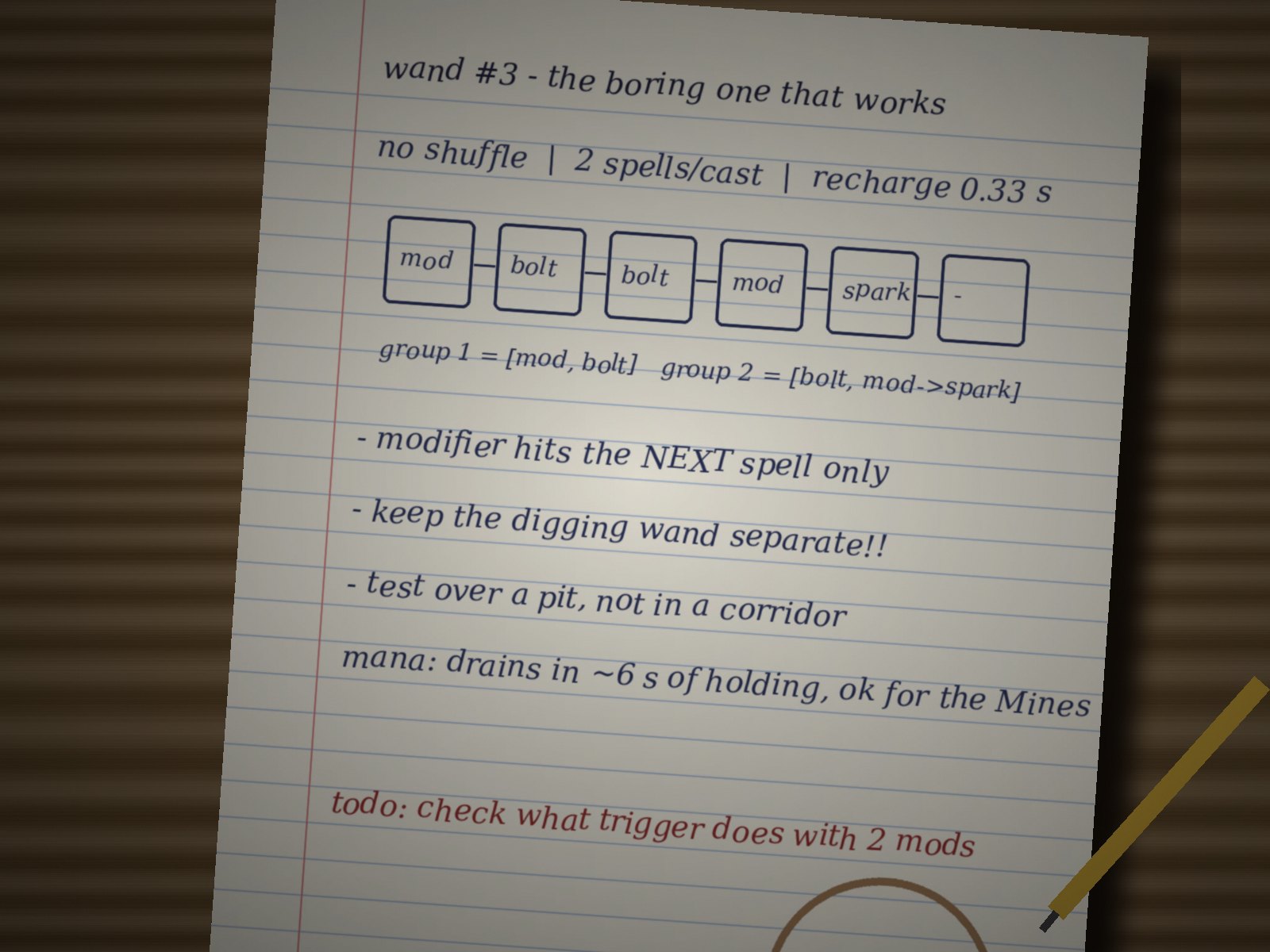
Most modifiers change the next projectile that is drawn. Put the modifier first, then the thing it modifies. When a wand casts several spells at once, the modifiers are shared across that whole group, which is how small wands end up surprisingly strong.
Read a wand like a list
It helps to think of a wand as a deck of cards that is dealt from left to right. Each cast takes cards from the top until it has enough projectiles for one "group"; modifiers picked up on the way stick to that group. When the deck runs out, the wand reshuffles (or, without shuffle, just restacks) and you wait out the recharge. Drawing this on paper for a new wand takes a minute and saves a lot of surprises — the photo above is exactly that.
Triggers, briefly
A trigger projectile carries more spells with it and releases them when it hits something. Those extra spells come out of the same deck, so a trigger near the end of the list can quietly eat the start of your next cast. If a trigger wand feels inconsistent, count the cards: it is usually that. (This is also the part our Wand Lab simulator currently gets wrong, which is why its beta is offline.)
A boring wand that wins runs
- No shuffle, two or three spells per cast, recharge under half a second.
- One reliable projectile repeated, one modifier that helps it travel (or not hit you).
- Keep a separate digging wand. Mixing digging and fighting on one wand is how people fall into lava.
Digging wands
A digging wand does not need to be strong, it needs to be predictable: a short recharge, no shuffle, and nothing that bounces. Carry it as a separate wand and switch to it on purpose. The number of runs that ended because someone "just quickly dug through" with their fighting wand is not small.
Things that hurt you
Anything that explodes, bounces or homes in on the nearest target can and will find you. Test new wands over a pit, not in a corridor.